Showing posts with label zanzibar. Show all posts

Monday, June 7, 2010

Into Uganda

The Night Boat

From Zanzibar, we chose to return to Dar Es Salaam via the night boat, a ferry that leaves the island at 10pm, sits offshore for a few hours and then sails overnight to Dar Es Salaam for a 6am arrival. In theory, this meant we could sleep during the voyage and save on a night's accommodation. Our seats were comfortable enough, but due to several factors, it didn't go as planned.

Firstly, there is the issue of air-conditioning. I am perplexed about how the bodies of Africans work. Seeing as they stroll around in dress pants and sweaters in the kind of heat us Canadians can barely endure in shorts and tshirts, I would assume their systems are accustomed to warmer temperatures. But whenever there is an opportunity for air-conditioning, they really crank it, and seem to delight in icy-cold air that Alanna and I, again with our minimal clothing, find it hard to fall asleep in.

Secondly, Africans will happily fall asleep anywhere, irrespective of comfort level or surrounding distractions. (This is easy to explain, once you've seen the conditions under they're expected to take their naps as toddlers – Africa babies spend much of their day strapped to their mothers' backs with an expertly knotted sheet or blanket, and we've seen children dozing peacefully in this manner while their mothers hoe patches of soil on a hillside.) As we were getting settled, a TV at the front of the ferry treated us to a martial arts film, and we assumed once it ended bedtime would officially roll around. But they kept coming, at substantial volume, one after another (one of which, for those who care, featuring the gratuitous toplessness from a former high school classmate), throughout almost the entire night. And everyone slumbered on regardless.

Finally, it was a very rocky journey. Alanna and I both have fairly sturdy stomachs, but even I was feeling the quease. Alanna had to visit the bathroom, and in the morning described it rather nightmarishly as this chaotic, vomit-coated chamber full of angry squatting women.

So anyways, we arrived in Dar Es Salaam at sunrise with barely any sleep at all, which was too bad.


Uganda

The crowned crane, Uganda's national bird.

From Dar Es Salaam we caught a plane (again with the frigid air) to Entebbe, Uganda, bypassing what we saw as a week spent in iffy busses over bad roads. Entebbe is notable as the site of the 1976 hostage-rescue raid by the Israeli army during Idi Amin's reign, dramatized in The Last King of Scotland. It was therefore a historically poignant introduction to a country, but not surprisingly the airport was a pretty standard airport – though apparently there are still a spray of bullet holes in the command tower.

Prior to guidebook blurbs, our knowledge of Uganda amounted to its depiction in Last King of Scotland (the book of which Alanna and I have since read) and the excellent documentary War Dance, exploring the lives of refugee-camp children as they prepare for a national dance competition. And this is Uganda for most people – if your mind doesn't immediately come to rest on the horrors of Idi Amin regime, then you may instead think of the more recent bloody civil conflicts, such as the atrocities committed by the super-evil Lord's Resistance Army. Or the AIDS epidemic, or the general hunger, poverty and malaise associated with much of the continent. 'Tourist Mecca!' does not rank high on the list.

But the country has been stable and relatively peaceful since the 80's, and our airport shuttle led us through trim suburban greenery on our way to the hostel, past roadside flowerbeds and within view of Lake Victoria's sparkly shores. A far cry from the smog and grit of Dar Es Salaam – not to mention whatever pitiful dustbowl I'd had in mind. (One would think we'd have moved beyond the whole 'exceeded expectations' schtick, but apparently not.) Most African countries have a bigger middle-class than one would imagine, and Entebbe came across as a clean, comfortable town, quiet and cool. On our walk into town we passed a squad of jogging soldiers – public singing in Africa, whether it comes out of a church or from a mass of buff sweaty army dudes, always inspires a potent envy – and were introduced to Uganda's healthy population of marabou storks, teenager-sized and pretty disgusting.

We also became acquainted with a new (questionable) mode of transportation, the motorcycle taxi, or boda-boda. At African borders, the two countries' respective posts are often separated by a wide no-man's land, and the name comes from their origin shuttling passengers between the two posts, border-to-border. Like minibusses, boda-bodas are often painted bright colours and decorated with Christian or Muslim (or nonsense) expressions. Also like minibusses, they appear in varying states of roadworthiness. The accident rates for these things are appalling, but everyone uses them: businessmen, the elderly, and many mothers, who use them as a school-bus system. Women always ride in dignified side-saddle fashion, although we read an amusing newspaper article recently about 'hot-blooded' drivers blaming the wandering hands of their female passengers as a leading cause of collisions. Helmets for both driver and rider are supposedly the law.


In Entebbe we visited the Wildlife Education Center, a facility the locals call a 'zoo' though it is in fact a rehabilitation center and sanctuary for injured or rescued animals (the difference amounting mainly to the quantity of guilt one feels in attending). While it wasn't cheap – twenty bucks a pop – it was a most gratifying animal experience. We were able to gaze at most of the creatures you'd hope to see in Africa, including lions, rhinos, crocs, deadly snakes, and a ton of monkeys and chimps. And while one's typical zoo experience involves staring at a bored, lonely, motionless animal, these primates were active. They put on a show. We watched a group of red-tailed monkeys, and then an island of rescued chimps, for the better part of two hours. We were so, so happy. As icing on the cake, a troupe of vervet monkeys – a species we're almost not excited about anymore – wanders freely about the property, and are more comfortable with human presence than we're used to, letting us get very close.


red-tailed monkeys

Vervet monkey, chimps in the background.


At the WEC we went on a 'nature walk', basically a short dark tunnel through the hugest, creepy spiderwebs, populated by equivalently huge and creepy spiders.

Camels!

This group of Australopithecus were rescued in Mombasa. They're allowed to hunt certain kinds of protected antelope because "it's part of their culture" and "they've been doing it for literally millions of years."

Our plan after Entebbe was to visit the Ssesse archipelago in Lake Victoria, hoping for a similar experience from we'd had on Likoma in Malawi. We made it all the way onto the boat before turning back. We'd wanted to get to a specific place – Banda Island – and the men in charge of the boat headed there were dubiously vague about departure time, price, and trip length. The first quote was a ten-hour voyage, but once hearing we weren't interested, the man somehow let us barter him down to two hours, and then an hour and a half. If only it were always that easy. Not to mention the route has an unconvincing safety record – Phillip Briggs, our most trusted guidebook author, says he straps himself to a big plastic jerrycan every time he makes the trip. Plus there was a guy hassling us for money after carrying us both into the boat unsolicited. It just seemed like an all-round bad idea. We'd already created our share of not-fun boat memories for the trip, so we relocated all our valuables and electronics into chest pockets, waded to shore, and gave Banda Island a pass.
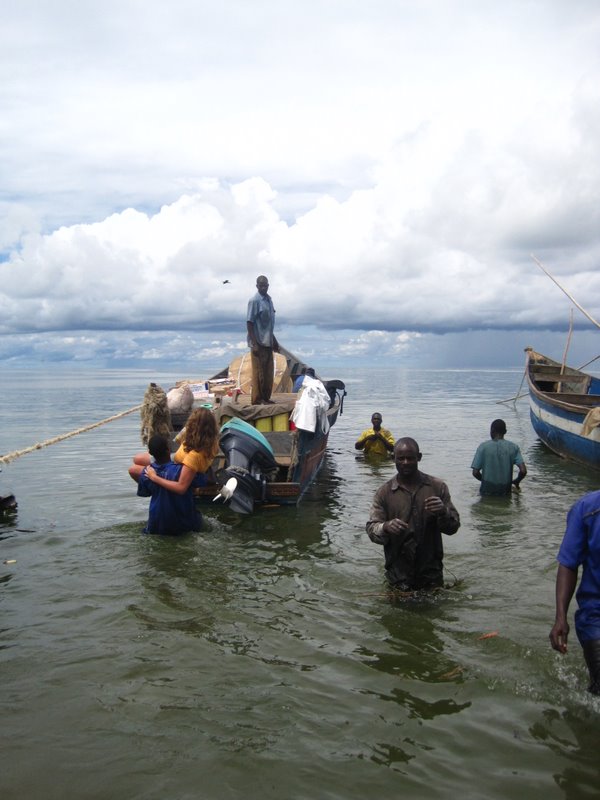

Which was fine, because someone else told us later the place was crap anyway.

Sunday, June 6, 2010

Jambiani

The morning we left Stone Town for the legendary beaches of Zanzibar's east coast, it rained. For the next three days, it rained. On the fourth day, the sun shone through and we caught a glimpse of what we were beginning to think we might only see on postcards, but mostly our beach holiday was characterized by rain, at times heavy, giving way to light showers and drizzle in the afternoons, with a 90% chance of an evening thundershower. Or y'know, just plain old heavy rain.


Needless to say, there was a lot of Toto singing going on.

We had known going into this that we would be visiting Zanzibar in the low season, a period known – quite aptly as we would find out – as 'the long rains'. Hailing from the Pacific Northwest, we figured we knew what rain was and how to deal with it (brellies, wellies, Gore-tex and the like), but I think it's safe to say that Africa has redefined our concept of wet weather. When it rains, it pours. And as for that rain jacket you've been toting around for three and a half months thinking that you can't send it home because you'll be happy you have it when the rainy season comes? The fact is that no matter how water-proof you manage to make yourself, when the rains come, there's really no avoiding getting wet, soaked, saturated to the bone. This is no pina coladas and getting caught in the rain, this is a tall glass of more-than-you-bargained-for and getting caught unprepared.


Jambiani village is stretched over a few kilometers of coastline, and is described by Lonely
Planet as “a sunbaked and somnolent collection of thatch and coral-rag houses”. (The writers of Lonely Planet seem to have an affinity for the word 'somnolent' and will use it any chance they get, regardless of whether or not it actually applies – in this case, unlike Dar Es, it does). Arriving in Jambiani in the rain, we were met with the definition of somnolence: boarded-up shops, empty streets, women and children huddled under leaky awnings – everything wet, everything grey, everything not looking at all like the postcards.


We had hired a car and driver in Stone Town to tour us around our beachfront accommodation options in Jambiani, and hopefully score us a deal. The first place we went was a lovely 2-bedroom suite, with bathroom, kitchenette and private yard that usually went for $80/night. It was offered to us for $40, but as we didn't really need that much space, and $40 is still a little more than we're used to paying, we decided to move along. In total, we visited five places, two of which were closed for the season, two of which were open for business but completely vacant, and one of which won our vote with free breakfast, wireless internet and imitation Vache Qui Rit cheese. I'm pretty sure I can withstand just about any meteorological condition nature can conjure up if there's cheese to be had – especially if that cheese is packaged in cute little wedges and contains what is probably 150% of your annual recommended intake of saturated fat.

Despite appearances of being shut for the season, on our walk through town we met numerous people who invited us into their homes/restaurants and offered their services as tour guides, dhow captains, taxi drivers and in the case of Mr. Fruit, deliverers of fresh Zanzibari produce. In search of a place to eat lunch one afternoon, we passed the 'Karibu Restaurant' – a pile of saturated plywood and moldy thatch topped by a family of goats. Naturally, we figured Karibu Restaurant was no more, and continued along on our search for food. It was only on our way back to our hotel that we met the restaurant's proprietor, Hassan, who informed us that he was very much open for business and urged us to let him cook us dinner. Unable to say no to home-cooked fish masala, we gave him a few dollars to buy seafood, and promised to return at seven.

As it turns out, Karibu Restaurant is undergoing an extensive renovation thanks in part to the generous donations of travellers from all over the world who have eaten Hassan's food over the past 15 years. Therefore, we were welcomed (or Karibu-ed) into the family home, and seated in a makeshift nook decorated with faded photos of satisfied customers and a deflated beach ball inexplicably hanging from the ceiling. Unusually for Africa, the food was delivered to our table very promptly, and in copious quantities. We had each ordered a serving of curry, one with rice, one with chapati, and Hassan had cooked us an additional eggplant dish “as a gift” – he did not want us to leave hungry. The food was delicious, but far too much for two people, no matter how hungry. Apparently, huge portion sizes are a point of pride at Karibu Restaurant, where you eat, as the sign states, “antil you say Hassan please don't kill me with food”. Hassan is also quite proud of the fact that a photo of his sign exists somewhere on the Internet, and I suppose I should write to tell him that now it exists twice – with all this publicity, he should expect a big turn-out for his re-opening.


The following day, we awoke to a welcome change of scenery: what once had been dark and grey and dismal had given way to vivid blues, greens and the whitest sand I have ever seen. The Lonely Planet is in fact spot-on with their description of the sea's “ethereal shade of turquoise” and with the sun finally shining, we hurriedly pulled on our swim suits for the first time since Likoma and made a beeline for the water. Unfortunately, the ocean we encountered was not at all like the ocean we were expecting – at home, you are rewarded for a bold dive into the depths with invigorating refreshment, in Tanzania, you just end up feeling sticky, and even more uncomfortably hot than before. It's not luke-warm, it's just plain warm, and with the long tides, getting out to dive-able depths would likely take you hours of wading through thigh-deep bathwater. It was probably one of the least satisfying dips I've ever taken, but the scenery was indeed some of the most memorable.


So that was our vacation from our vacation – a little disappointing, slightly more indoor reading than we may have counted on, but enough colourful characters and subtle adventures to make the rather expensive cab ride worthwhile. Plus, being the only patrons to an entire stretch of resort accommodation, willing to brave less-than-ideal conditions for the promise of cheaper prices and an empty stretch of sand, we were made to feel like the intrepid travellers we like to imagine we are. And there's no shaking that feel-good feeling of being someone's first customer in weeks – never a waiter more happy to see you. Of course, we tipped generously, our travel egos reaching critical mass.

Monday, May 31, 2010

Zanzibar: Stone Town

Zanzibar has been a standout destination for Alanna and I ever since we began our Africa research. The name alone conjures an old-world exoticism shared with the likes of Timbuktu and Casablanca. These are places about which I know nothing, but prior to the trip Zanzibar seemed to be a member of the same club, and evoked the same vague ideas of coastal African decadence (incense, steamer trunks, monkeys with hats, et cetera). I still haven't a clue about the other two (they may well not even exist anymore!) but at least we've got Zanzibar pegged.


The tropical island, part of an archipelago of the same name, is as historical as it gets – it's been a major player in intercontinental trade routes since the first century and Stone Town, the island's largest and most famous settlement, has been a town for about as long as people have been naming things 'towns'. At various points in its history the island has belonged to Persian and Arab traders, Omani sultans, the Portuguese, and the British, who controlled the island under a protectorate until it unified with newly-independent Tanzania in 1964. Zanzibar is a significant world supplier of spices, most notably cloves, and is famous for its carved doors and implausibly beautiful beaches.

Door!

More doors! The brass studs are to deter war elephants, obviously.

Zanzibar operates partly as an independent state – I'm not sure how it works but we had to pass through customs upon arrival after a four-hour ferry ride from Dar Es Salaam. We spent the trip cooped in a comfy VIP section (VIP-ness and caucasian-ness being synonymous, apparently) while Muslim prayers played a little too loudly on small TVs. The 'MV Flying Horse' docked in the harbour next to a huge pile of shipping containers, an introduction that didn't exactly scream either 'old-world' nor 'exoticism'. After entry formalities we rapidly became best friends with a middleaged tout who was more than willing to lead us to our hotel. Assuming he'd demand payment for his services we were apprehensive, but another man in the crowd yelled, “you can follow this man, he will not ask you for money!” so off we went. Our impromptu guide hurried us into the narrow maze of streets, all the while providing us with a detailed itinerary of the Zanzibar spice tour (the long-winded explanation of the Zanzibar spice tour is an area of expertise of all touts, we would soon learn). The info was nice and all, but he kept our attention to a point that, once reaching the hotel, we had no recollection of how we got there.


For me, Stone Town was beyond disorienting. The map in our guidebook resembles a bunch of carefully arranged shards of broken glass. It took us a few tries to figure our way back to the ferry dock, where the street was wider and we could find our way to the more touristy shops. Stone Town has what I've heard described as a 'tourist ghetto,' a sterile, compact district of air-conditioned souvenir stores and restaurants seldom visited by any local who's not a security guard, a taxi driver or one of Zanzibar's merciless touts. But Stone Town's tourism setup is such that this was virtually the only place we could find to eat – possibly because if any restaurant opened in more stimulating surrounds, no one would be able to find it.

The view from our hotel's rooftop terrace.

Drinking coconut from a vendor. First he hacks off the top with a knife and hands it to you with a straw. Once you're finished you hand it back and he expertly scrapes all the meat out of the inside and gives it back to you. It's different from coconuts at home, the meat is soft and gelatinous.

common sights: texting, unrefrigerated meat.

Stone town is noted for its unique mix of Arabic, Persian and Swahili architecture, which all seem to be variations on large dim multi-storey buildings with few windows. Often, if it weren't for the many storefronts at ground level, exploring the deeper reaches of Stone Town would feel like walking a narrow alley between two old prisons. It's only once you get above the buildings, or manage a peek into an open door, that you realize that most have courtyards, and the balconies and windows face inwards. The shops themselves – when they aren't a row of needy curio vendors – are suitably old-fashioned: closet-sized convenience stores, woodworkers' shops, and tailors seated at antique Singer sewing machines.


One of the dozens of curio vendors, all hawking the same stuff we've been seeing since Zambia.

A definite highlight – and the one instance where we were able to participate in something not reserved for tourists – were the meals at Forodhani Gardens. Every night at sundown the harbour-side park converts into a street-food market, where forty or so tables sell variations on a few themes: chapati rolled with egg, skewers of fruit, and, most popularly, barbequed seafood. The men behind the tables are all polished salesmen, assuring you of the freshness of the day's catch and the dedication and integrity of that table's respective team of fishermen.


The spreads at some of the seafood tables are astounding: lobster, shrimp, octopus, calamari, and often five or six kinds of fish including marlin, swordfish and shark. As with the rest of Africa's fishing industry, it does make one a little worried at the amount of seafood left in the sea. All is precooked – your selection is reheated over a grill and served with sauce and salad over your choice of flatbread, all for about three bucks.


Cane juice was something that Alanna discovered in Dar Es Salaam, and is a most refreshing and perfectly-balanced beverage. The long cucumber-width cane is pressed mechanically with a few key limes and a shard of ginger and sieved straight into your glass, a large beer-mug's worth for about fifty cents.


Our other activity of note in Stone Town was the world-famous spice tour, which was half fascinating, half making fun of a high-maintenance family of Americans. Instead of visiting a true spice plantation, our guide walked us through a demonstration forest, showing us a plethora of spices in their living form, peeling bark and crushing leaves for us to smell and taste. Never have my fingers been more aromatic! Not surprisingly, most spices look pretty boring when still in the ground.

vanilla!

peppercorns

nutmeg

After a visit to some very dull Persian ruins we were served a delicious lunch, cooked by some local women and incorporating many of the spices we'd just seen. To cap the day off we were to visit a beach – Alanna and mine's first saltwater since South Africa and our first Zanzibar Shore Experience. Well, after a long backroad drive we emerged onto possibly the filthiest, most unswimmable, least appealing stretch of sand on the island. Alanna and I, being the easygoing, non-complaining type, would have probably plunked ourselves on a maggoty log and sat there for the allotted hour, but luckily a talkative older woman in our group demanded to be taken to a better beach. Our driver obliged, and we were bussed to a more suitable spot. The new beach was divided down the center, split between an upmarket resort and a crowded fishing village. On your left, people are using the beach as a surface on which to sun themselves and nibble tapas, on your right people are using the beach to stay alive.

dirty beach

In flowery guidebook introductions the world over, Stone Town is unanimously exalted for its magical, time-capsule quality. Possibly the victims of lofty expectations, we found this to be a little exaggerated. Yes, it's a spectacular place – one does get the impression that life has been rolling along without much variance for centuries, and the carved doors are indeed the handsomest things on hinges, but at the end of the day a narrow stone street is just a narrow stone street. (But what was I expecting? Dancing girls with bells on their toes? Cardamom tossed from the rooftops?) I'll admit that the robed, soccer-playing children and noble old men congregating at the mosques did make one reflect on one's modernity (and, come to think of it, one's exposed ankles). In the end, with all it's become, we felt it was difficult to access what makes Stone Town so special. There's a funny paradox to traveling: the places attempting to cater to tourists are always the places we don't want to be. Imagining Stone Town fifty years ago, we probably would have enjoyed it a little more, when the hassle involved would simply have been the challenge of getting by in a culture different from one's own – for us at least, a much more appealing option.