
 Nhkata Bay
When confronted with the prospect of leaving our glorious island retreat after a seven days, Alanna and I shared a similar sentiment: why bother? Here's a place where you're on a first-name basis with each of your fellow guests (and your bartender), where the village kids bring you roasted Malawian tree-nuts with no motive other than to expand your worldly food knowledge, where the beach could be mistaken for somewhere in the Caribbean except no salty residue! These things add up. In our eyes, to return to mainland Africa was to willfully subject ourselves once again to the gauntlet of cramped minibusses, hassling curio vendors, scary border posts, prospective muggers, ticks, warlords, pushy prostitutes, the lack of french toast, et cetera. But the itinerary prevailed, and after one last stop at the bar for something for Dad (can't you hardly wait, Dad?) we shipped out.
Well, it did not take long for the dreaded gauntlet to close its walls around us (contingent, of course, on a gauntlet being something that has walls). The Ilala ferry was four hours late, and boarding the ship was just as perilous as getting off a week before, except it was carried out in complete darkness. (On top of this, Alanna and I had the extra challenge of maneuvering on and off the lifeboat while attempting to hold our styrofoam takeaway containers upright, but that was of our own doing.) We reached Nkhata bay at 3 o'clock in the morning. The ferry was meant to pull up to a jetty (which makes disembarking quick and painless) but it was currently under repair, and unusable. The Ilala lowered its lifeboats and just... sat there.
We bobbed around in the tiny bay for four hours. Word eventually came round that using the lifeboats on this stretch of shore was deemed unsafe (ha!) so the plan of action was, evidently, to bide our time until the earth's natural cycles gently eroded the beach into a less hazardous shoreline. I guess it was decided that was going to take too long (Malawians are so impatient) so the Ilala moved to an adjacent bay and disembarking began. The happy ending to this episode is that we were picked up in a private rowboat that took us directly to our hostel and that we will never have to get into an Ilala lifeboat ever again.
 Looks so innocent, don't she?
Nkhata Bay is a popular stop with those traveling through Malawi, and the lakeshore is dotted with much budget accommodation. We secured ourselves a lovely double room with views of the lake at Mayoka Village. We'd heard unkind things about the area – swarms of pushy vendors and that it is, in general terms, a “dunghole” (I've polished the language some), but our experiences were all positive. Walking into town meant passing a long strip of curio hawkers, but they were mostly of a Rastafarian persuasion and reluctant to leave the shade of their huts. In town, we took our business to a womens' crafting collective (oh how I love you, price tags and indifferent salespeople!). Having prepared ourselves with returning to meat-and-maize for three meals a day, we were happily surprised at the food (homemade pumpkin ravioli and zucchini-flower tempura, anyone?) and fresh fruit juice, long-overdue.
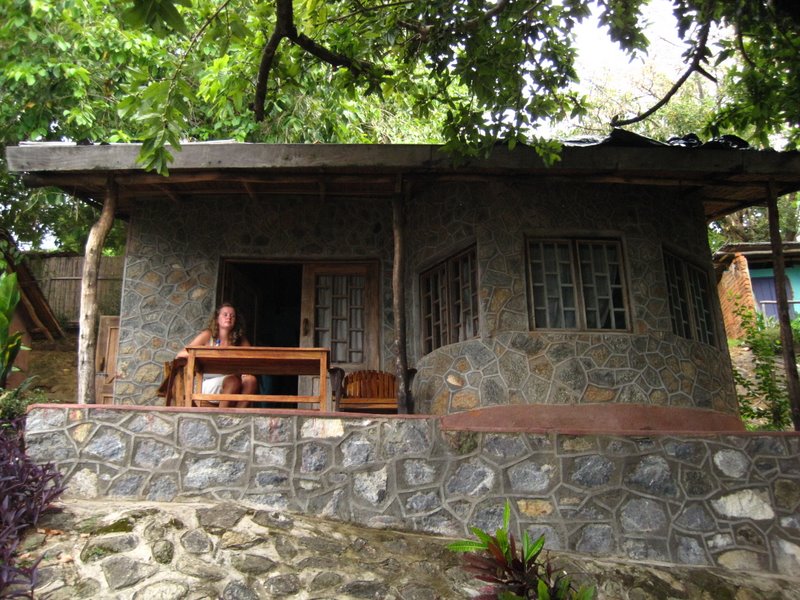
 Lunch in town, a regional soccer match for entertainment
 Life's essentials at the market (spot the sleeping man)
 Mayoka Village shoreline
Our next destination was Livingstonia, after a short stopover in Mzuzu, where we slept at a strange hostel run by a pair of severe alcoholics (or did we just catch them at a bad time? I don't think so). Like the town of Livingstone in Zambia, it's named after David Livingstone, the explorer/missionary/much-admired Doer-of-Good who, like Cecil John Rhodes, seems to have left his mark all over the continent. Livingstonia is perched sort of in the middle of nowhere atop a plateau overlooking Lake Malawi, and is most easily accessed by a 15km-long dirt track that begins at the lake's shore and snakes up the side of a mountain to the village, 700m up.

In the blistering sun, that's a decent hike. All our guidebooks warned us that transport up the hill was scarce and walking was often the only option, but we'd met many travellers who had either been to Livingstonia or were headed there, and there was a hostel of good repute a little ways out of town, so we decided to give it a shot. We disembarked our minibus at the turnoff, and after a snack of Coca-Cola and mandasi (semi-sweet balls of deep-fried bread) we ventured forth. The first thing we encountered was the first thing we often encounter wherever we go: children (there are a lot if them in Africa, if you haven't heard). And the script is always the same: “hello! Hawayoo? Give me money! Give me sweeti! Give me pen!” The delights of Africa children probably deserves its own post, but I'll say this – the kids ask for these things but I'm sure it's just a shot in the dark, a 'might as well try' situation (on Likoma all we ever heard was “give me ballooni!” meaning one legendary person at some point got off the Ilala with a big bag of balloons and everyone since has had to deal with the repercussions). It's part of the ritual of interacting with kids here, and once they know you don't have anything to hand out they're just as open and sweet. Anyway, on the road to Livingstonia it was different: a small group of kids ran up and asked for the usual (funds, confections, writing utensils) and on learning our pockets were empty, they settled for “hugs?” Long story short, Malawi is great.
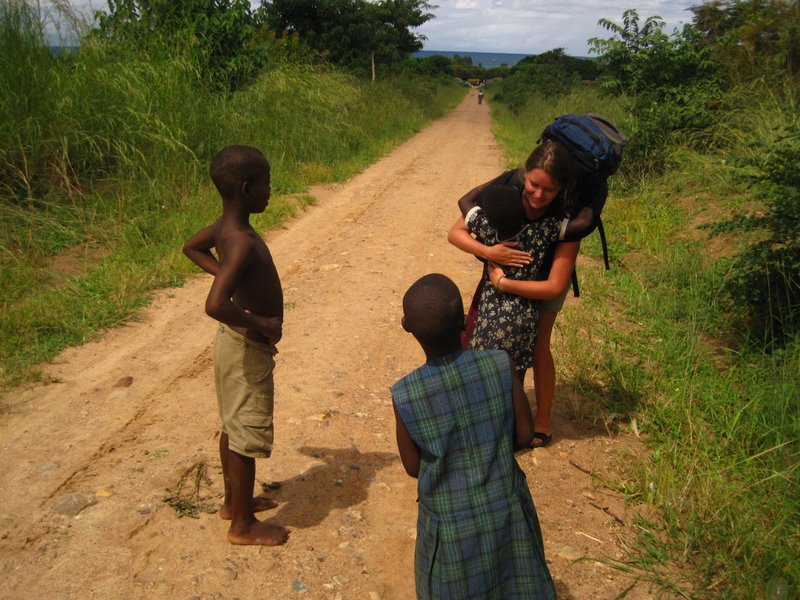
After an hour of swimming up the mountain in our own perspiration, we flagged down a shiny new pickup truck, a Livingstonian driving his British holidaying friends up the mountain. They were more than happy to let us cram into the back with their luggage and supplies. They invited us into the cab but we gestured towards our armpits and politely declined. So we summitted in style, passing many more unlucky souls, all locals, trekking up and down the road, often with heavy-looking head-cargo.
We spent three lovely nights at the Mushroom Farm Campsite, a rustic, small-scale non-mushroom-farming place with picturesque compost toilets (there's a word combo!) and a kitchen running entirely on wood heat. They provide tent pads (we rented a tent for $4) and a few thatched huts, all perched on the edge of a spectacular cliff overlooking at what felt like half of Malawi. Here we rendezvoused with friends from Likoma (one of which we've been running into periodically since Pretoria and just recently said our final farewells here on Zanzibar) and made a few more. Dinner each night was served by candlelight around a tiny table and we could have stayed much longer.
 A view like this...
 ...means a sunrise like this
On the second day we walked into Livingstonia, another two hours up the road on foot. Originally settled by the Scottish as a mission, there was much ado in various literatures about the architecture ('charming' and 'colonial' were thrown around a lot) and what we found was a long, sleepy avenue dotted with muted brick buildings and many pine trees (I've detected a strong correlation between white missionaries and pine trees and it is a mystery). Nothing revelatory – if I'd lugged my entire life up a mountain on horseback I wouldn't be in the mood to worry about ornamentation either – but pretty charming indeed. There was a small museum displaying a creepy old decaying latex anaesthesia machine.

On the walk to Livingstonia. It had just rained, and the mud was perilously slick, but this kid ripped past on his way down screaming his head off. And oh look, a view!


The other thing to do near Livingstonia is to visit the waterfalls, a twenty minutes' walk from the mushroom farm. Nearing the trailhead to the falls one undoubtedly gathers a throng of young “guides” (indispensable, really) who will lead you down a short path to the top of the falls, a swimmable pool above, and a couple of small caves behind the falls themselves. What with South Africa's drought and Victoria Falls' excess, we've been starved of some good waterfall-viewin', and this certainly fit the bill. Lots of water plunging a great distance into an amazing lush valley, with more views than you can shake a small child at.

From the top of the falls...

...and looking back.

An aerial acrobatics demonstration. The pool was about a meter deep.

These hard-working guides led me to a cave behind the waterfall.
The slogan on the Mushroom Farm's business cards is “Tired of the Beach?” Impossible, of course, but it was refreshing to get into the mountains, up where it's cooler, greener and 'humid' rather than 'muggy.' Livingstonia was our last stop in Malawi, a country that lived up to every high expectation, with possibly the world's best inland beaches, its friendliest people, and one unforgettable old boat. And we got (almost) through without mentioning Madonna.
-------------------------------------
Hey! You've made it to the end of the post!
Crazy Awesome Contest Time!
Crazy Awesome Contest Time!
Malawi once had a president named Banda. He declared himself to the post for life, and got a little senile and did some iffy things, like commissioning a brand-new, sort of weird 'capital city' to be built next to the existing capital, Lilongwe.
He also ordered a nationwide ban on a certain song.
What was that song and why?
The first person to comment with the correct answer will receive a handmade card handwritten and addressed to you from Alanna and I (the card was not handmade by us, Malawians did it). Parents, I think you're getting cards already, so maybe leave the playing field open for now.
The game is on, Huzzah.


 Posts
Posts

